
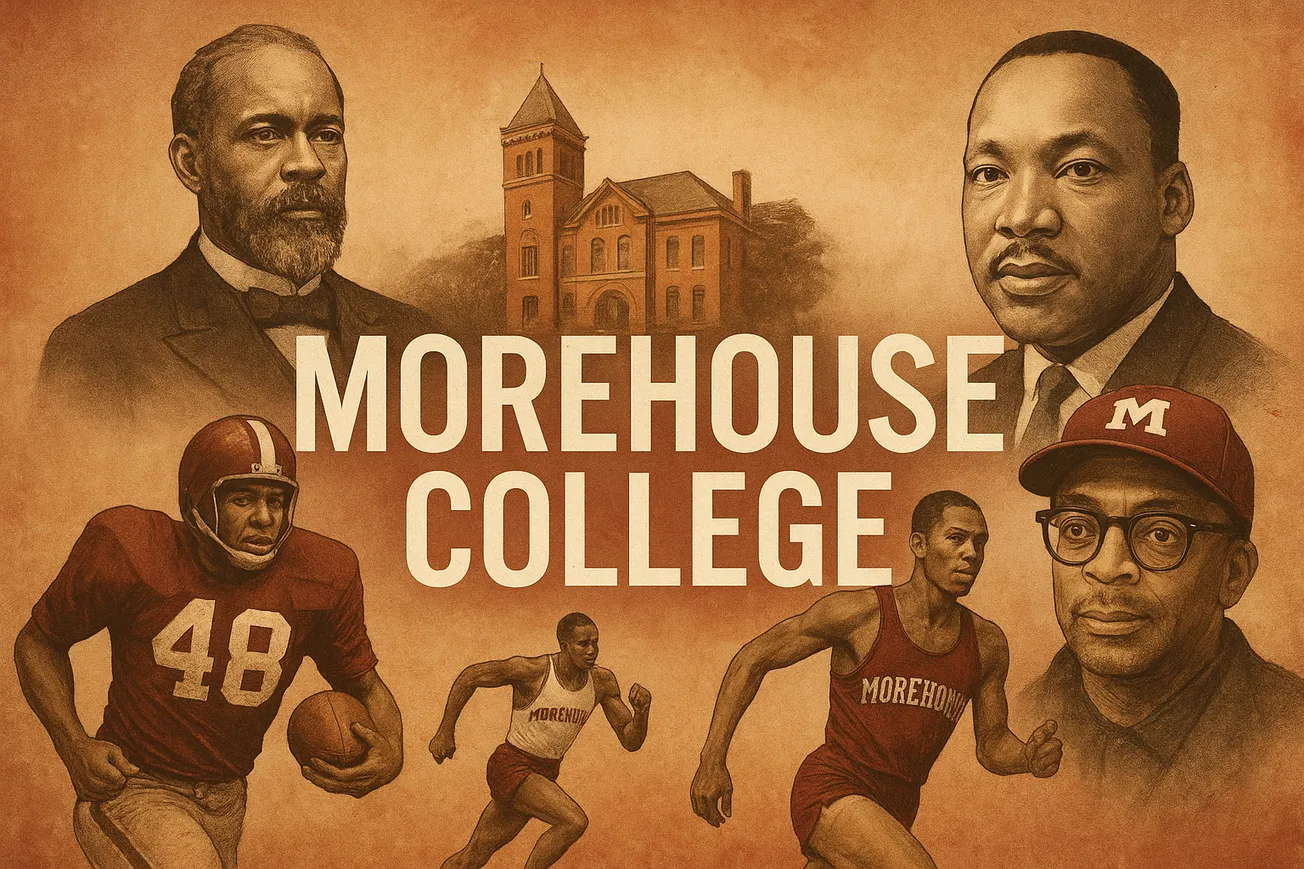
The red-brick buildings of Morehouse College have witnessed history in the making since 1867, when two Baptist ministers and a former slave founded Augusta Institute in a church basement with just 37 students and a revolutionary dream: to educate newly freed African Americans in the post-Civil War South. That humble beginning in Augusta, Georgia, would grow into something extraordinary.
In 1879, the school moved to Atlanta and became Atlanta Baptist College. By 1913, it had transformed once more, taking the name of Henry Lyman Morehouse, a Baptist minister who championed education for freedmen. But names were just the beginning of the transformation. Morehouse was building something far more profound—a brotherhood, a tradition, and a launching pad for greatness.
Walking through the campus today, you can almost hear the echoes of a young Martin Luther King Jr., who entered Morehouse at just 15 years old in 1944. The son and grandson of Morehouse men, King would graduate in 1948 with a degree in sociology and a calling that would change America forever. His mentor, Benjamin Mays, Morehouse's legendary president, instilled in him the philosophy that would undergird the Civil Rights Movement. King would later say that Morehouse taught him to think—not what to think, but how to think.
Champions on the Field and Court
While Morehouse's academic legacy towers tall, its athletic tradition runs deep. The Maroon Tigers have produced exceptional athletes who've excelled far beyond the college arena. Edwin Moses, who graduated in 1978 with a degree in physics, didn't just dominate track and field—he revolutionized it. The two-time Olympic gold medalist in the 400-meter hurdles went undefeated for nine years, nine months, and nine days, winning 122 consecutive races. His analytical approach to hurdling, developed through his physics studies at Morehouse, transformed the sport's technical understanding.
The football field has seen its share of Morehouse magic too. Though the college competes in Division II, it has produced NFL talents who carried the Morehouse spirit into professional sports. These athletes embodied the college's philosophy that excellence in one arena should complement excellence in all areas of life.
Lights, Camera, Leadership
Perhaps no one embodies Morehouse's creative spirit more vividly than Shelton "Spike" Lee, class of 1979. The filmmaker who would give America "Do the Right Thing," "Malcolm X," and "BlacKkKlansman" discovered his artistic voice in Morehouse's nurturing environment. Lee often returns to campus, filming there and hiring Morehouse men for his productions, keeping the connection alive and vibrant.
Before he became one of Hollywood's most recognizable voices, Samuel L. Jackson was a Morehouse man, graduating in 1972. His journey from the Atlanta campus to becoming one of the highest-grossing actors of all time began in Morehouse's drama program, where he first discovered his commanding presence that would later electrify screens worldwide.
Boardrooms and Breakthroughs
The Morehouse influence extends powerfully into corporate America and public service. David Satcher, class of 1963, would become both the U.S. Surgeon General and the director of the Centers for Disease Control and Prevention—the only person ever to hold both positions simultaneously. His journey from a Morehouse biology major to the nation's top doctor exemplified the college's ability to nurture scientific minds with social consciousness.
In technology and business, Morehouse men have broken barriers repeatedly. The college has produced more Black male doctors, lawyers, and PhDs than any other institution in the United States. Its alumni lead Fortune 500 companies, serve as college presidents, and pioneer innovations across every field imaginable.
Herman Cain, the former CEO of Godfather's Pizza and presidential candidate, graduated in 1967 with a mathematics degree. Maynard Jackson, who became Atlanta's first Black mayor and its youngest ever at age 35, was a Morehouse man. These leaders didn't just break glass ceilings—they built new rooms entirely.
The Brotherhood Bond
What makes Morehouse unique isn't just its impressive alumni roster but the profound sense of brotherhood it instills. The college's tradition of producing "Renaissance Men"—intellectually curious, socially conscious, and professionally excellent—continues today with approximately 2,200 students who call themselves "Men of Morehouse."
The institution's crown jewel moment came in 2019 when billionaire investor Robert F. Smith stunned the graduating class by pledging to pay off all their student loans—approximately $40 million worth. It was a gesture that embodied the Morehouse tradition of lifting as you climb, of success measured not just by personal achievement but by how many others you bring with you.
Today, Morehouse remains the only historically black, all-male, four-year liberal arts college in the United States. Its campus, now spanning 66 acres in Atlanta, continues to be a crucible where young Black men are forged into leaders, thinkers, and change-makers. The mission that began in a church basement 157 years ago burns as bright as ever: to develop men with disciplined minds who will lead lives of leadership and service.
From the pulpit to the boardroom, from Olympic podiums to Oscar ceremonies, from scientific laboratories to the halls of Congress, Morehouse men continue to shape the world. They carry with them not just diplomas but a legacy—a responsibility to excellence and service that defines what it means to be a Man of Morehouse.
In the words of Benjamin Mays, "It must be borne in mind that the tragedy of life doesn't lie in not reaching your goal. The tragedy lies in having no goal to reach." At Morehouse, every man learns to reach high, reach far, and most importantly, reach back to pull others forward.


