
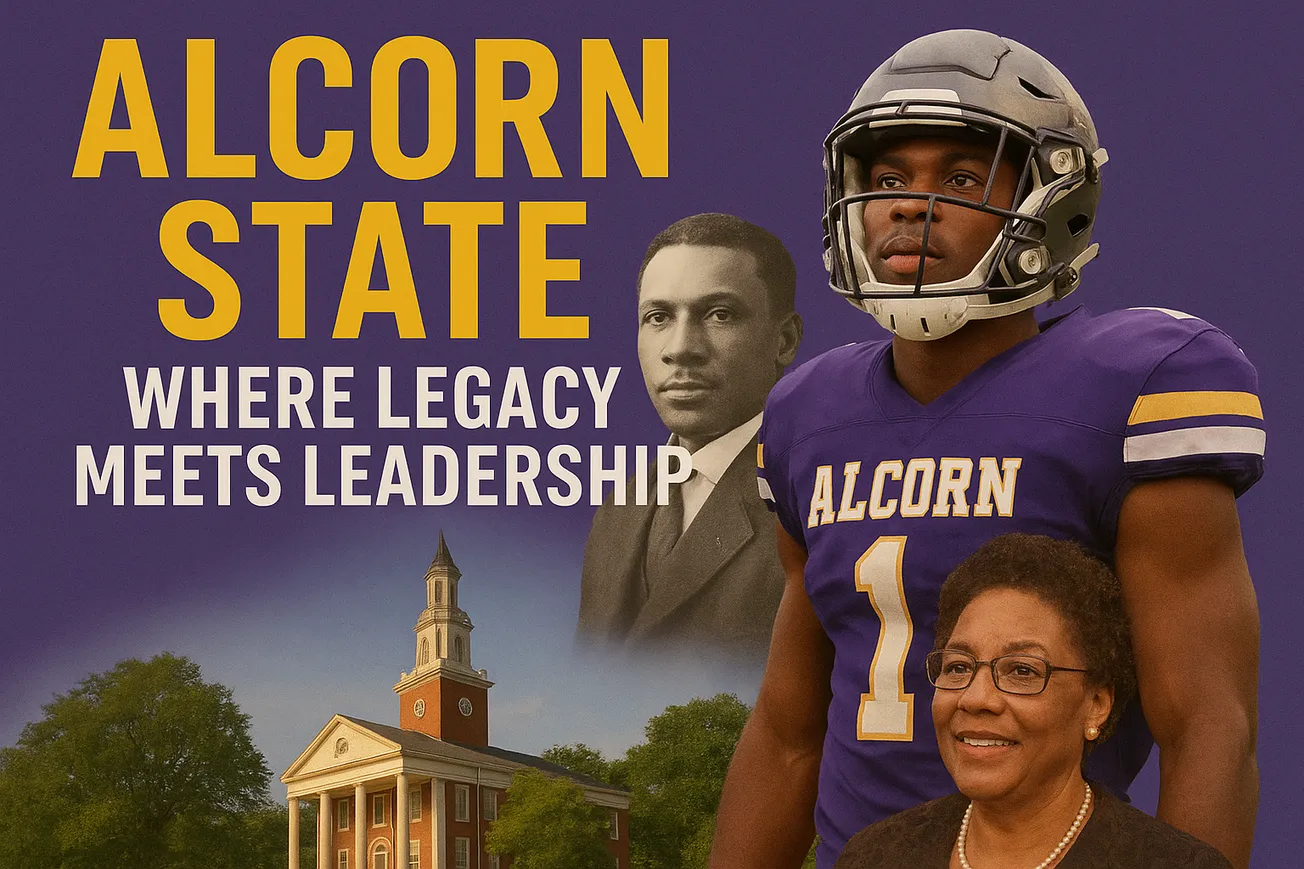
When you walk across the leafy quad of Alcorn State University in Lorman, Mississippi, you step into 150+ years of history woven together by courage, scholarship, and achievement. Here’s a story of how Alcorn began, how it grew and the people it’s sent into the world who’ve made it proud.
Origins: Planting Seeds in Reconstruction
In 1871, in the aftermath of the Civil War, Alcorn was born. It was founded by the Mississippi legislature as Alcorn University, named for Governor James L. Alcorn, to educate the formerly enslaved and their descendants. The site was purchased from Oakland College, a Presbyterian school which had closed during the war.
Its first president was Hiram R. Revels, who made history himself as the first African American to serve in the U.S. Senate. He left that post to lead Alcorn.
At first a university in name, but modest in resources: eight faculty members, about 179 students, and a focus on agriculture, mechanics, education—hopes many shared in that era.
Through time, the institution evolved: in 1878 becoming Alcorn Agricultural and Mechanical College, adding women (in the late 19th century), expanding its academic offerings. Finally, in 1974, it was renamed Alcorn State University, reflecting its broader mission.
The Campus, Its Character
Alcorn occupies over 1,700 acres, many for agriculture and research, others for classrooms, dorms, and athletics. A defining landmark is Oakland Memorial Chapel, originally part of Oakland College; it survived the Civil War, became part of Alcorn, and is now a National Historic Landmark.
From the Field to the World Stage: Famous Sports Alumni
Alcorn isn’t just about classrooms—it has a strong athletic tradition, and many students have gone on to shine in professional sports and beyond:
- Donald Driver (Class of ’99) is perhaps the most famous. A wide receiver with the Green Bay Packers, he played 14 seasons, caught over 10,000 yards, 743 receptions, and became the Packers’ all-time receiving leader. He earned multiple Pro Bowls and won a Super Bowl (XLV). He was also a standout in track & field at Alcorn.
- Steve McNair, another Alcorn legend, is celebrated as the first African-American quarterback to win the AP NFL MVP award. He was third in Heisman Trophy voting and had a storied NFL career with the Houston/Tennessee Oilers/Titans and the Baltimore Ravens.
- Jimmie Giles Jr., who shone at both football and baseball, was an elite tight end in the NFL during the late 70s and 80s, known for his hands, blocking, and athleticism.
- Marcus Hinton made waves as a tight end at Alcorn before playing briefly in the NFL and in other leagues. His college stats—record-setting receiving yards, touchdowns—are a reminder of how Alcorn can elevate talent.
Other athletes: Roynell Young (football), Mildrette Netter White (Olympic gold in track relay).
Beyond Sports: Alumni Who Changed the World
Alcorn’s impact reaches well beyond the athletic fields. Its graduates have shaped civil rights, culture, education, and leadership.
- Medgar Evers is one of Alcorn’s most powerful legacies. An alumnus, he became a field secretary for the NAACP and a martyr for civil rights—assassinated in 1963, but still an enduring symbol of courage.
- Josephine McNeill Posey, an author and academic, wrote histories of Alcorn and became the first female dean of its School of Education & Psychology.
- Bill Foster, a Hall of Fame pitcher in the Negro Leagues, also coached at Alcorn. His achievements both on the mound and in mentorship are part of the school’s rich athletic and cultural heritage.
- Leslie Frazier, another athletic alumnus, went on to head coaching in the NFL (Minnesota Vikings), and has carried the leadership skills he developed as a student-athlete at Alcorn into his coaching.
- Dr. Chandra Minor—a trailblazer in other arenas—became the first African-American female orthodontist in Mississippi, showing the reach of Alcorn’s influence out of sports and into science / health fields.
Why Alcorn Matters: Themes & Takeaways
Alcorn has always been more than a school—it is a crucible of opportunity. From its founding, with precious little support, it has educated those whom society often left behind. It showed that land‐grant universities for African Americans could thrive, grow, and innovate. Over decades:
- It broke barriers (first women students, first public Black land‐grant college, etc.).
- It fostered excellence in adversity: many alumni succeeded during segregation, economic hardship, limited resources.
- It’s produced leaders in many fields—sports, civil rights, education, science—demonstrating that talent from HBCUs shapes the nation.
A Moment You Should Know
In 1984, under legendary coach Marino Casem, Alcorn State had a perfect 9–0 season and was ranked No. 1 in the final NCAA Division I-AA poll—the first time a black college had ever finished its regular season at #1 in that ranking.
And in more recent years, Donald Driver’s induction into the Packers Hall of Fame (2017), and his being an all‐time receiver in one of the NFL’s most storied franchises, shows that the school continues to send talent that performs not just collegiately but at the highest level.
Alcorn State University isn’t just a school—it’s a legacy. It reminds us that education can be a beacon carved from modest beginnings; that sports can be a platform to show character; and that even if the odds are stacked, excellence, perseverance, and leadership can flourish.


